More Leads Don’t Fix a Broken Funnel — Lead Quality Does
You have two options:
Option A: 100 leads. 2% conversion rate. 2 deals.
Option B: 10 leads. 20% conversion rate. 2 deals.
Which would you choose?
Most business owners choose Option A without thinking. More leads feels safer. More leads feels like growth. But both options produce the same revenue.
The difference? Option B costs 1/10th the marketing budget and 1/10th the operational stress.
This is the lead quality problem. Most businesses are obsessed with lead volume when they should be obsessed with lead quality.
The Problem: Chasing Quantity Over Quality
Here’s what I see constantly:
A business owner’s lead volume drops. They panic. They increase ad spend. They buy more leads. They run more campaigns. They chase volume.
But what they don’t ask is: are these leads even good?
They don’t ask which leads converted fastest, what those converters had in common, or which leads ghosted and why. So they keep chasing quantity, spending more money to get more leads, most of which are garbage.
Meanwhile, a competitor in the same market focuses on lead quality. They get 40 leads instead of 100, but 35% of them convert instead of 2%. They make 2x the revenue on 40% of the budget.
This is why some businesses scale. Others just get busier.
Why Quality Beats Quantity
Let me walk through the math:
Low-Quality Volume Strategy
- 100 leads/month
- 2% conversion rate = 2 deals
- Cost-per-lead: $50
- Total spend: $5,000
- Revenue: $4,000
- Profit: -$1,000
High-Quality Strategy
- 20 leads/month
- 20% conversion rate = 4 deals
- Cost-per-lead: $150 (you’re selective)
- Total spend: $3,000
- Revenue: $8,000
- Profit: +$5,000
High-quality wins on three dimensions: lower total spend, higher conversion rate, higher revenue. Plus, your team deals with 80 fewer ghosts, fewer no-shows, fewer tire-kickers. Your follow-up system is less stressed. Your sales team closes deals faster. Your customer satisfaction is higher.
This is why some businesses feel sustainable and others feel like a hamster wheel.
What Most Businesses Do Wrong
Mistake #1: Define “lead” as “anybody who filled out a form.” Not all form-fillers are leads. Some are tire-kickers. Some are price shoppers. Some are just curious. A 65-year-old retiree asking about HVAC doesn’t convert the same as a 45-year-old homeowner with a broken system in July.
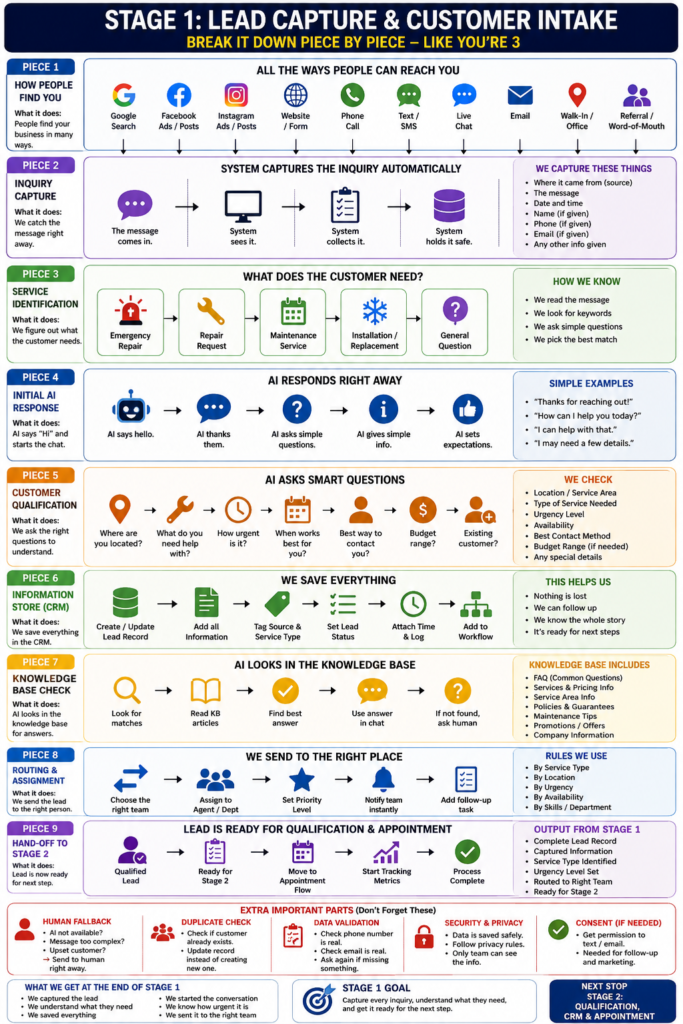
Mistake #2: Never segment or qualify leads. All leads get dumped into the same bucket. A qualified emergency repair lead gets the same follow-up speed as a “just gathering info” lead. Your team treats them all the same because they treat them all the same.
Mistake #3: Optimize for volume instead of conversion. Every decision favors more leads: “Should we run ads targeting broad keywords or narrow keywords?” Broad keywords = more leads. Narrow keywords = higher conversion. Most pick broad.
Mistake #4: Never audit which leads actually convert. You don’t know what a “good lead” looks like. You don’t know if conversion correlates with lead source, time of day, age, location, or the keyword they came from. So you can’t replicate good leads. You’re shooting in the dark.
Mistake #5: Spend more before optimizing conversion. When volume drops, the first instinct is to increase ad spend. But if your conversion rate is 2%, spending more just gets you more bad leads. The answer is always: fix conversion first, then scale volume.
The Fix: Implement Lead Quality Scoring
Here’s how to flip from quantity to quality:
Find the Leak
Audit your last 50 leads. How many converted? How many ghosted? How long did each take to convert? What do converters have in common — age, location, source, timing, intent? What do ghosters have in common?
Create a lead quality score based on what you find. For example: emergency repair request = 8/10 quality, general inquiry = 3/10 quality, request during business hours = +2 points, request from a past customer = +3 points.
Fix the Leak
Update your lead source targeting to favor high-quality sources. Pre-qualify leads before spending money on follow-up. Adjust ad targeting to attract higher-quality leads with narrow keywords and specific demographics. Build a follow-up sequence based on quality score — emergency repairs get an immediate callback, general inquiries get an educational email sequence.
Recover the Revenue
Once you know what a good lead looks like: cut spending on low-quality sources, double down on high-quality sources, improve follow-up speed for high-quality leads, and run different messaging and offers to different lead quality tiers.
How to Know If You’re Chasing Quantity
Can you name the conversion rate for leads from each source? If not, you don’t know which sources are quality.
Do you have a lead scoring system? Or do all leads get treated the same?
When volume drops, do you increase ad spend or improve conversion? If you increase spend, you’re optimizing for quantity.
Do you track how long from lead to close? If not, you can’t tell which leads are real and which are tire-kickers.
Is your follow-up speed the same for all leads? Or do high-quality leads get faster callbacks than general inquiries?
If you’re optimizing for quantity, your business will always feel like a hamster wheel.
The Path Forward
Stop chasing 100 leads. Start chasing 10 good leads.
Score your leads. Identify patterns. Double down on quality sources. Kill low-quality sources.
Your revenue won’t drop. Your stress will.
This is how businesses scale sustainably.