You Can’t Fix What You Can’t See
Could you actually explain your own funnel, start to finish, in five minutes? Most business owners can’t — not because it’s complicated, but because nobody ever mapped it. That’s Stage 1 of the 6-stage build.
Ask most business owners to explain their funnel in five minutes, and they can’t. Not because the funnel is complicated — because nobody ever mapped it.
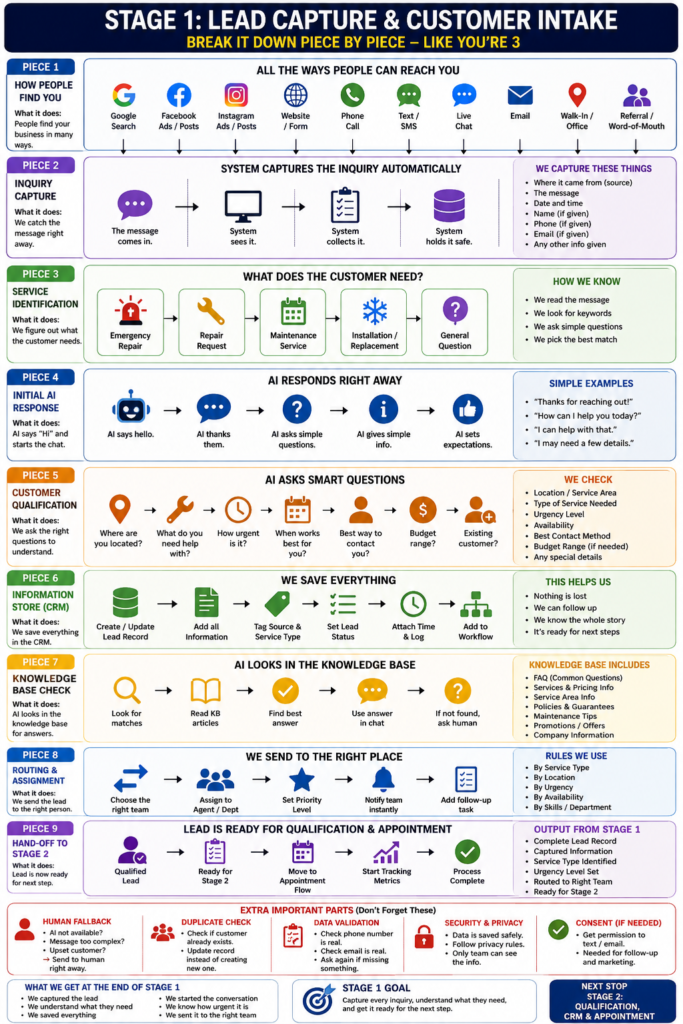
A System Overview is a complete map of your revenue-generating process: lead sources, entry points, forms, landing pages, automations, human touchpoints, CRM stages, follow-up sequences, appointment processes, and customer onboarding. Before you can repair anything, you have to see the entire system — not the parts you remember, the parts that actually exist.
The Five Problems That Show Up Here Most
No documented Funnel SOP — everyone runs the process a little differently.
Nobody can explain the customer journey the same way twice.
Tool overload — five platforms holding the same customer data.
No clear ownership of each funnel stage.
Documentation that describes a funnel you don’t actually run anymore.
None of these are dramatic. That’s exactly why they’re expensive — they don’t throw an error, they just quietly cost you consistency, and consistency is what turns into revenue.
A funnel is not a website. A funnel is not a CRM. A funnel is a revenue-generating system — and you can’t optimize a system you haven’t mapped.
Once you can see the whole system, the next question is where leads actually enter it — which is Stage 2: Multi-Channel Capture.
Grab the full diagnostic and worksheet for this stage in The Funnel Repair Manual.