What Gets Ignored Gets Expensive
Would you actually notice if your funnel started slipping? Most funnel failures aren’t sudden — they’re slow. That’s exactly why they’re dangerous.
A response time creeps up. A conversion rate quietly drifts down. Nobody notices because nobody’s watching that specific number — until the quarter ends and the revenue gap is impossible to ignore.
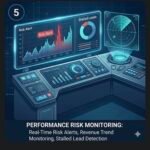
Performance Risk Monitoring is the ongoing process of measuring funnel health and catching trends, risks, and failures before they create major business impact. The goal isn’t collecting data for its own sake — it’s catching problems early enough that fixing them is still cheap.
The Five Ways This Gets Skipped
No KPI dashboard — nobody has one place to actually look.
Reactive management — problems get addressed only after a customer complains.
Vanity metrics — traffic and impressions get watched instead of revenue-tied numbers.
Inconsistent reporting — the numbers change depending on who pulls them.
No risk thresholds — there’s no defined point where “watch it” becomes “fix it now.”
Performance improves when it’s measured. What gets ignored gets expensive.
A revenue-generating system requires visibility, measurement, and accountability. What isn’t monitored can’t be improved consistently — it can only be reacted to, usually after it’s already expensive.
Monitoring tells you where a leak is forming — but not every leak should be automated away. Some require a person. That’s Stage 6: Human Intervention Protocol.
Grab the full diagnostic and worksheet for this stage in The Funnel Repair Manual.
What Gets Ignored Gets Expensive
Would you actually notice if your funnel started slipping? Most funnel failures aren’t sudden — they’re slow. That’s exactly why they’re dangerous.
A response time creeps up. A conversion rate quietly drifts down. Nobody notices because nobody’s watching that specific number — until the quarter ends and the revenue gap is impossible to ignore.
Performance Risk Monitoring is the ongoing process of measuring funnel health and catching trends, risks, and failures before they create major business impact. The goal isn’t collecting data for its own sake — it’s catching problems early enough that fixing them is still cheap.
The Five Ways This Gets Skipped
No KPI dashboard — nobody has one place to actually look.
Reactive management — problems get addressed only after a customer complains.
Vanity metrics — traffic and impressions get watched instead of revenue-tied numbers.
Inconsistent reporting — the numbers change depending on who pulls them.
No risk thresholds — there’s no defined point where “watch it” becomes “fix it now.”
Performance improves when it’s measured. What gets ignored gets expensive.
A revenue-generating system requires visibility, measurement, and accountability. What isn’t monitored can’t be improved consistently — it can only be reacted to, usually after it’s already expensive.
Monitoring tells you where a leak is forming — but not every leak should be automated away. Some require a person. That’s Stage 6: Human Intervention Protocol.
Grab the full diagnostic and worksheet for this stage in The Funnel Repair Manual.